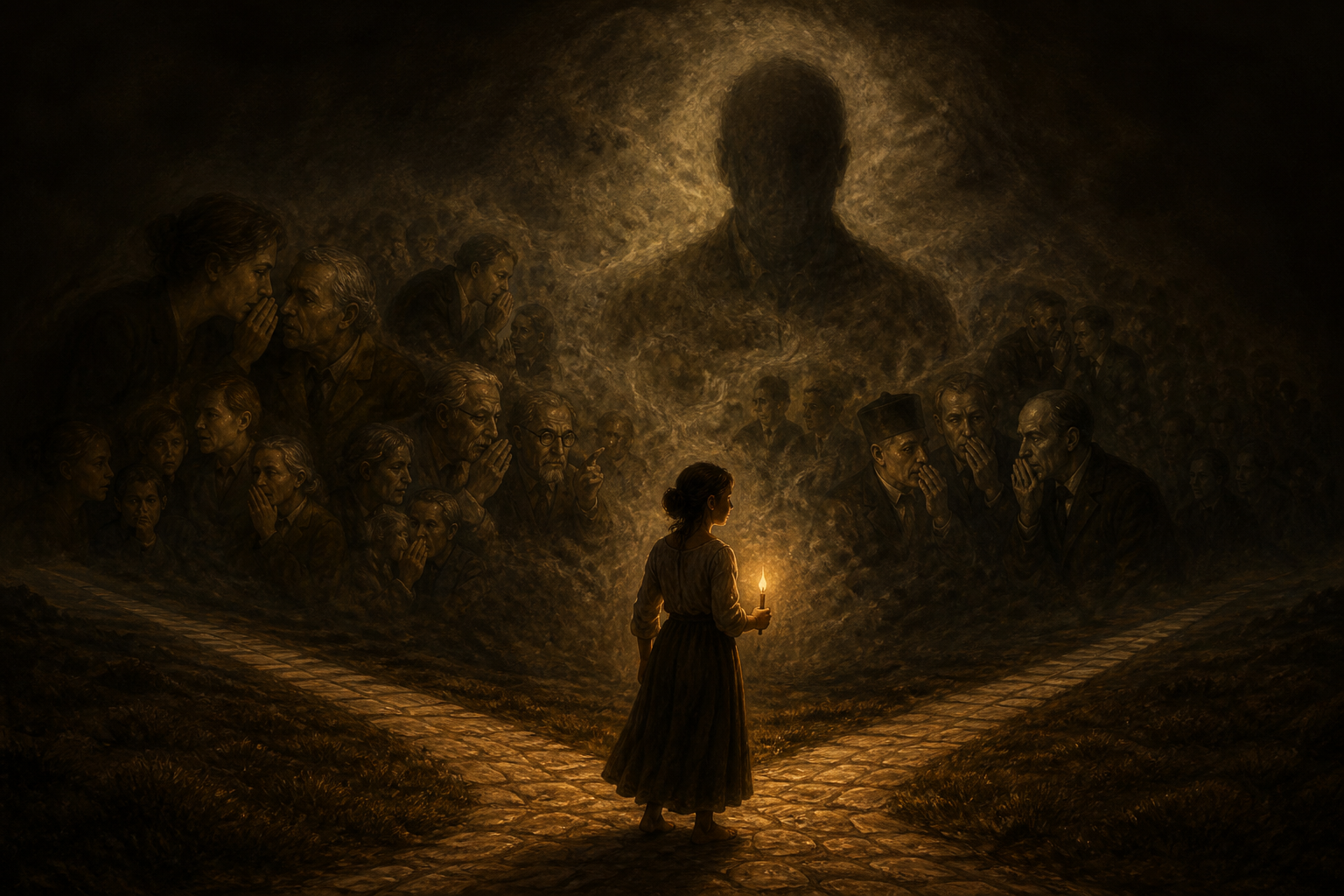
0. The Chorus · 零 · 众声合唱
“Someone else must know.”
父母、教师与公众的判断,渐渐聚成一个无形的权威。
Long before the animus shows up as a man worth looking at twice, it lives in her as something with no face at all:
a chorus of voices that moved into her head years ago and never left.
Anna is young.
She thinks about leaving the degree she hates.
Before the thought has finished forming, a voice answers:
That would be irresponsible.
She considers a man who does not fit the mold.
A second voice, calm as weather:
That kind of man isn't serious.
She imagines, for one whole minute, becoming an artist.
Be realistic.
None of these feel like opinions. They feel like the weather of the world — the way things simply are.
Her parents said some of these sentences. Teachers said others. The rest were contributed by ex-boyfriends, admired professors, priests, rankings, feeds, books, strangers.
Then the contributors faded, the way actors leave a stage.
The lines stayed behind, still being performed.
“People like us don't do that.”
“A successful woman should want this.”
“Obviously that wouldn't work.”
“Nobody respectable thinks that.”
This is the animus at its most unconscious.
It does not yet say:
“I think.”
It says:
“It is known.”
Here is the strange part: Anna can look fiercely independent from the outside. She has strong views. She argues well. She wins.
But ask her one question —
Why do you actually believe that?
— and something goes quiet in the room. Under the certainty there is very little investigation. The answer was there before the question. It was there before she was.
So her first task is not:
“Become more assertive.”
It is smaller, and far more unnerving:
“Whose voice is that?”
The moment she asks it, authority stops being weather and becomes a thing — visible, examinable, questionable.
And anything that can be questioned can, in time, become her own.

1. The Strong Man · 一 · 强者
“He can handle reality.”
她先在他人身上认出自己尚未领取的力量。
Years later, Anna is on the road with friends when the car dies.
Night. An unfamiliar highway. No lights in either direction. Everyone talks at once and nothing gets decided.
Then one man simply opens the door and gets out.
He looks under the hood. He moves everyone off the shoulder. He calls the right person, finds them a place to sleep, says little.
Nothing he does is miraculous.
Anna watches him work and feels something far out of proportion to a broken fan belt.
Oh.
The whole night reorganizes itself around his calm. Her shoulders drop. She did not know she had been bracing.
What she is discovering is not:
He's strong.
It is:
When he's here, the world is less dangerous.
This is the first classic mask of the animus:
physical potency.
The protector. The athlete. The soldier. The man who can lift, fix, endure, stand his ground.
Anna experiences strength as something that lives in other bodies, not her own. So the equation writes itself without her consent:
He is strong → therefore I am safe.
Which means her attraction is never only to the man. He has been hired, without being told, to carry her relationship to strength.
What she cannot yet hear inside the attraction is the actual sentence:
“I want to live in a world where reality can be confronted.”
At first she solves that want the old way: find someone who confronts it for her.
Then life intervenes, as it does.
A crisis comes when no man is available. She handles it. She fixes the thing herself. She says the hard sentence to the person she has avoided for years.
And afterward, standing in the kitchen with her hands still shaking, she notices:
I can handle things too.
The strong man does not stop being attractive.
He simply stops holding strength on her behalf.

2. The Hero · 二 · 英雄
“He makes things happen.”
方向感最初像是某个人替她展开的一片天地。
Later, Anna meets a different kind of man.
He is not imposing. He does not need to be. His life has direction, the way a river has a current.
He starts companies. He moves countries the way other people move apartments. He organizes, decides, departs. If he wants something, there is a plan by Friday.
Around him, Anna feels more alive than she can explain.
One evening he says:
Why don't you leave that job?
She laughs.
I couldn't.
He tilts his head.
Why?
And she opens her mouth and finds, to her astonishment, no answer in it.
This is the second mask:
action.
Initiative. Purpose. Direction. The man who walks into reality and leaves it changed.
Anna is no longer scanning the room for:
“someone who can protect me.”
Now she is scanning for:
“someone who knows where he's going.”
His life feels like a story with a plot. Standing next to it, hers starts to feel like one too.
But plots are possessive things.
Slowly she notices the pattern. Every time she loves a driven man:
his life becomes the plot.
Hers becomes the subplot.
He has:
a mission.
She has:
a relationship with someone who has a mission.
Then one ordinary morning, over coffee gone cold, the uncomfortable thought lands:
Perhaps she does not want his adventure at all.
What she wants is:
an adventure of her own.
The attraction had been smuggling a projection. What looked like:
“He is incredibly exciting.”
was also, all along:
“My own agency is starving.”
This is the hinge of the Hero stage.
Anna starts deciding before anyone grants permission. She initiates. She chooses. She learns the price — that choosing one road kills the others — and pays it anyway.
She stops being someone life happens to and becomes someone who can cause events.
The animus has moved one step further in.


3. The Man of the Word · 三 · 言说之人
“He understands what reality means.”
混乱的经验在语言中第一次显出形状。
Then Anna meets the Professor.
He may actually be a professor. Or a writer. A philosopher. A founder. A scientist. A political thinker. A spiritual teacher. The costume varies; the role does not.
They have dinner.
Anna tries to describe something she has felt for years and never once understood — a shapeless unease with no edges.
He listens. Then he says:
What you're describing is really about—
And he names it.
Exactly.
Something inside her clicks like a key turning.
That's it.
A fog she has lived inside for a decade suddenly has architecture.
This is seduction of a higher order than anything the strong man or the hero could offer.
Because language does what muscle and momentum cannot:
it tells you what things mean.
Anna's thoughts proceed in a familiar cascade:
He's brilliant.
Then:
He understands people.
Then:
He understands me.
And finally, quietly:
Perhaps he understands me better than I understand myself.
This is the third stage:
Logos.
The Word. The man who names reality.
The projection is no longer onto strength or agency. It is onto epistemic authority — the power to say what is true.
Anna reads everything he recommends. She picks up his vocabulary the way travelers pick up accents. She adopts his frameworks, his enthusiasms, and — though she would deny it — his contempts.
And whenever something new crosses her path, one small question arrives before all the others:
What would he think?
That question is the tell. It marks the exact address where authority still lives.
Then one day, the spell cracks.
The brilliant man holds forth on something Anna knows intimately — from the inside, in her bones.
And he is wrong.
Not stupid. Not lying. Just wrong, gracefully wrong, in elegant paragraphs.
She feels it in her body before she can argue it. His intelligence is real. His argument is beautiful. And her experience is telling her something else, and all three are true at once.
For the first time she can hold the two thoughts side by side:
He is extremely intelligent.
and:
He does not know everything.
It sounds obvious. It is not. It is the sound of three things that were fused together —
intelligence → authority → truth
— finally separating into distinct metals.
Anna begins asking a new kind of question:
Do I actually believe this?
Not:
Can I defeat his argument?
Not:
What is the respectable position?
Not:
Which famous person agrees?
But:
After I have listened carefully, what conclusion do I reach?
This is the beginning of inner authorship.
It is not yet the end of the road — because having your own opinions is still not the same thing as wisdom.


Interlude: The False Independence · 间奏 · 虚假的独立
“Obviously I'm right.”
外在的教授离开了,内在的裁判却接管了位置。
Here Anna can walk straight into a trap that looks, from every angle, like freedom.
She stops borrowing other people's opinions.
Good.
Then she becomes ferociously certain of her own.
I know what I think.
I don't care what anyone says.
I've figured people out.
Obviously this is how things work.
From the outside: independence, at last.
From the inside: almost nothing has moved.
The Professor has simply relocated into her skull.
Where she once heard:
“He says this is true.”
she now hears:
“Obviously this is true.”
Same voice. New address.
The animus still speaks in verdicts. It still wants every case closed. It still cannot sit in a room with ambiguity.
Which is why Jungian integration was never:
become assertive.
Or:
develop strong opinions.
Or:
become more rational.
Any of those can be possession wearing a new coat.
Something quieter and stranger has to happen.
4. Hermes · 四 · 赫尔墨斯
“What is actually trying to tell me something?”
未被承认的欲望,不会因理性而停止敲门。
Anna now has the career. Prestigious. Well paid. Everyone agrees she should keep it.
Her parents approve. Her partner approves. Her friends are envious. Her own rational analysis, run as many times as she likes, returns the same result:
Obviously stay.
And then the dreams begin.
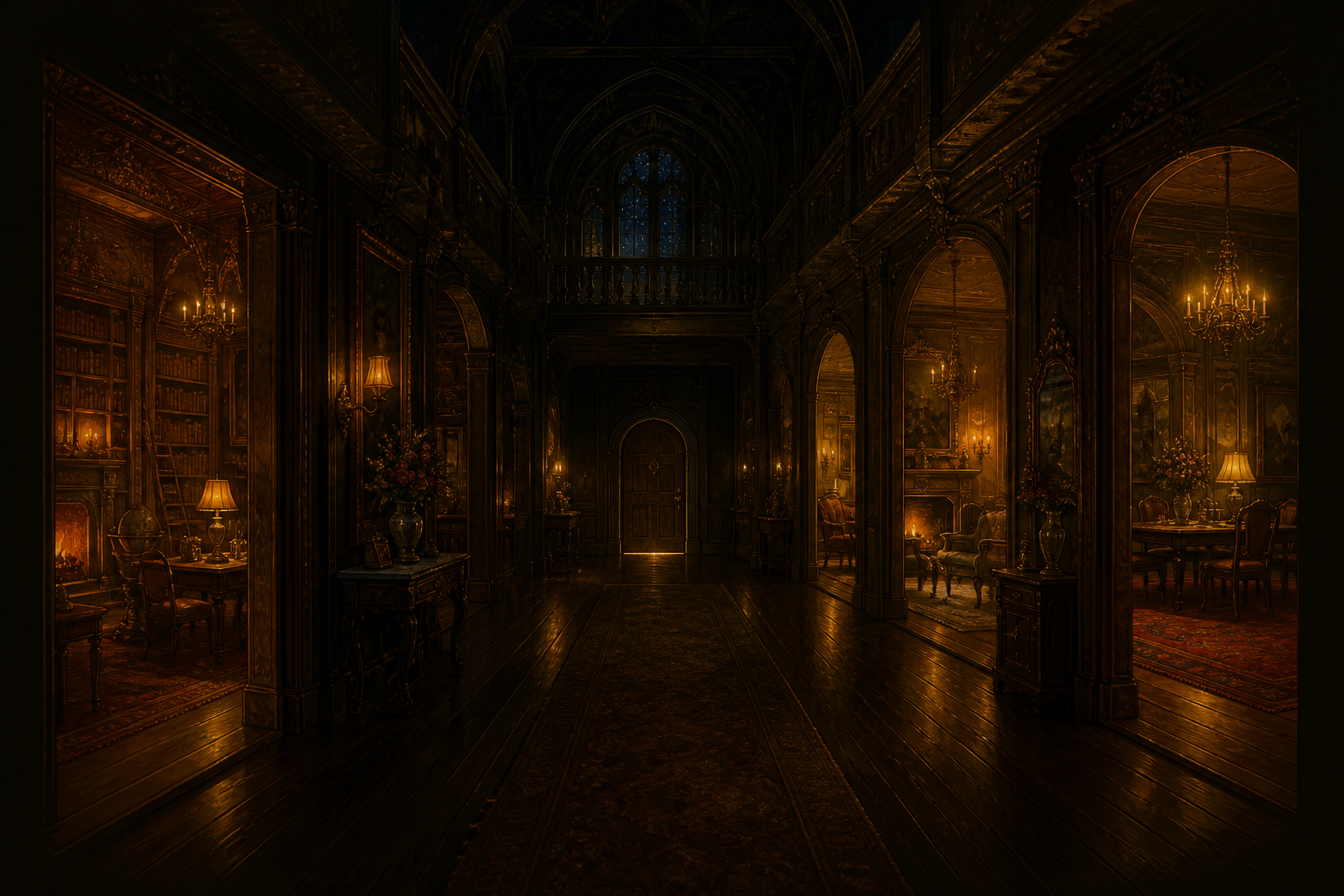
For months she dreams of the same house. Enormous. Beautiful. Nearly every room open and lit.
Except one.
At the end of a long hallway, a small locked door.
Again.
And again.
And again.
The younger Anna would have dismissed the dream. Or she would have found an authority and demanded:
Tell me what this means.
She does neither now.
She gets curious.
Why this image?
Why now?
What's behind the door?
What part of my life feels closed?
Then she starts collecting other evidence, the way you notice birds.
Every Sunday evening, a sadness arrives with no appointment.
She envies one friend in particular. Not the richest. Not the most beautiful. The one who walked away from a corporate career to make films.
Anna's first reaction is automatic:
That's ridiculous.
But a newer part of her asks, gently:
Why that friend?
And here the road reaches Hermes.
Why Hermes? · 为什么是赫尔墨斯?
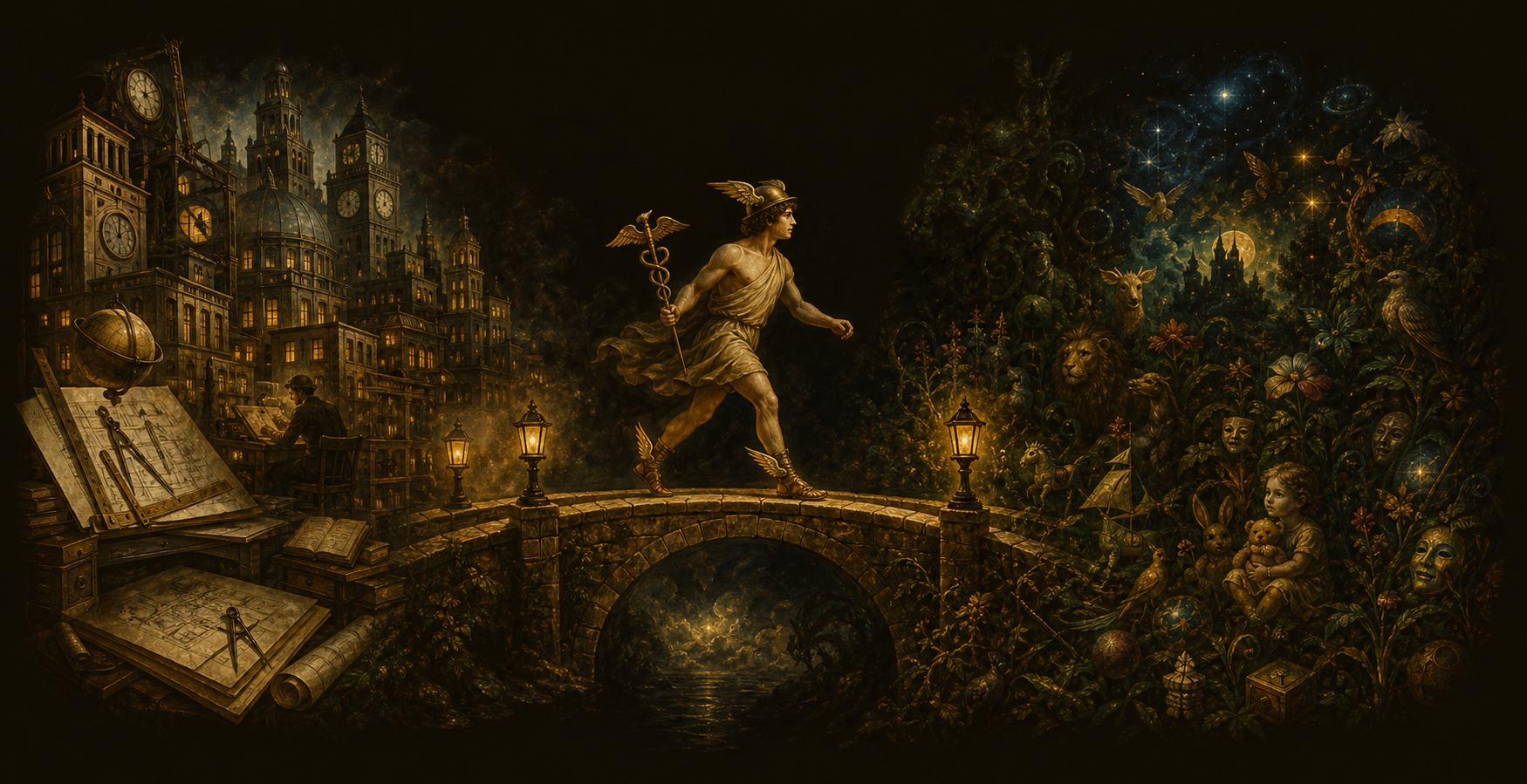
Hermes is the messenger.
He is the one god who can cross borders. Between gods and humans. Between the daylight world and the underworld. Between what is known and what has not yet become conscious.
Anna contains borderlands too.
There is the Anna who can explain her life flawlessly:
My career is excellent.
My relationship is stable.
I'm making rational decisions.
And then there is everything that refuses to fit inside the explanation:
dreams.
envy.
strange attractions.
bodily reactions.
recurring fantasies.
grief.
contradictions.
forgotten ambitions.
things she knows without knowing how she knows them.
Hermes is the capacity to travel between those two countries and carry news back.
Note carefully what he does not say:
QUIT YOUR JOB.
That distinction is everything.
Hermes is a messenger, not a dictator.
He says:
There is something downstairs you haven't listened to.
Anna can receive a message without obeying it. She can open the envelope and think.
Maybe the dream means she needs another vocation. Maybe she needs more creation inside the life she already has. Maybe she envies her friend's courage, not her profession. Maybe the locked room holds something else entirely.
The mature psyche does not demand an answer on the spot.
It can sustain a conversation.
Why Hermes becomes · 赫尔墨斯为何成为
“What do I actually think?”
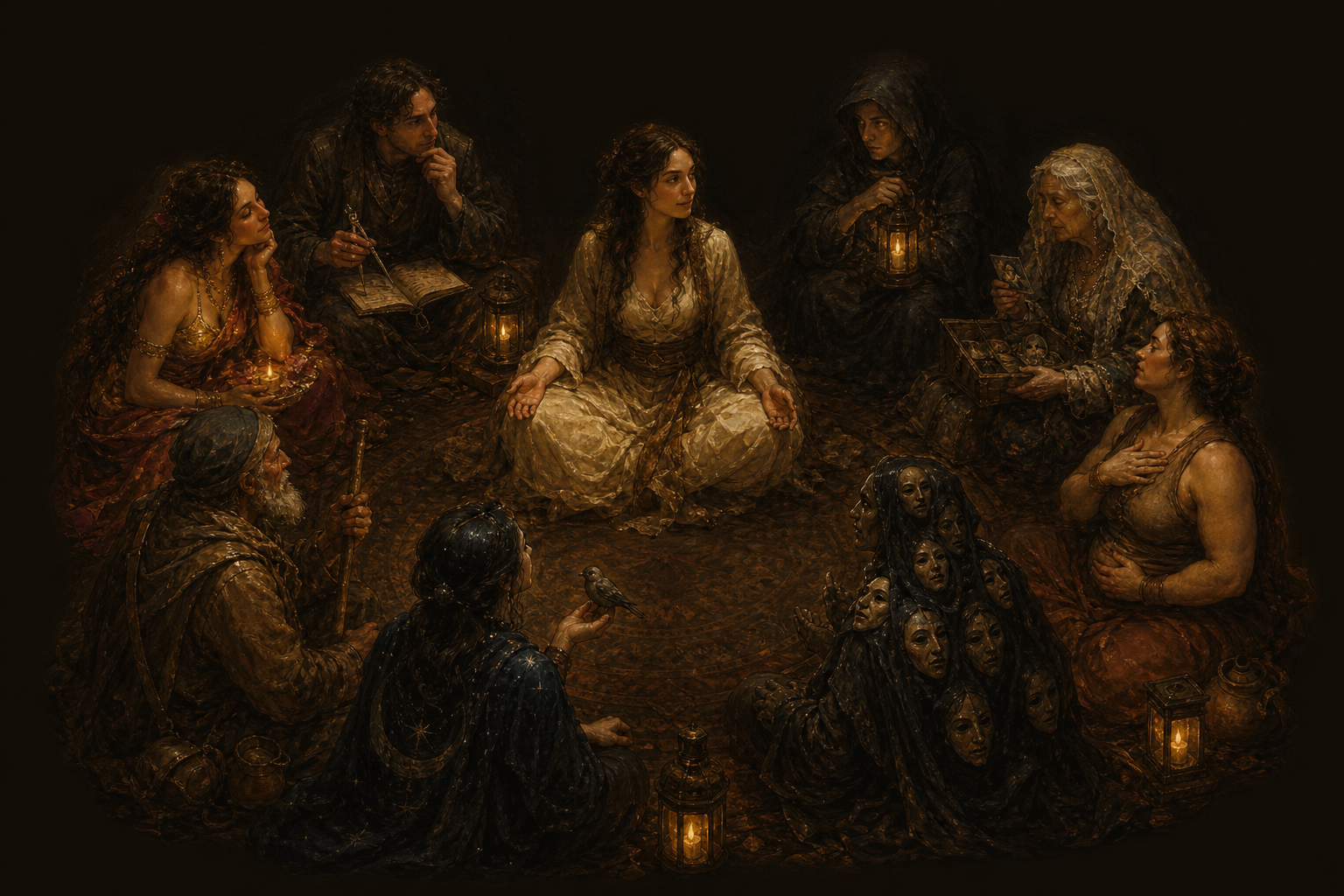
理性、身体、记忆与直觉都能发言,却没有谁独占王座。
This is the subtle turn, and it is worth slowing down for.
At every earlier stage, the animus handed Anna answers.
Step 0:
People know what is right.
Step 1:
He knows how to handle things.
Step 2:
He knows where to go.
Step 3:
He knows what is true.
At Hermes, the whole geometry changes.
Anna stops asking:
Who has the answer?
She asks:
What is happening inside me that I haven't yet understood?
And then:
Having listened to reason, experience, other people, emotion, intuition, dreams, incentives, and consequences—what do I actually conclude?
That is why I translated Hermes as:
“What do I actually think?”
With one widening of the word. “Think” here is larger than opinion.
It means:
What is my actual judgment once all the voices have been heard?
The mature animus is not one more voice shouting:
Here is the answer.
It is the function that carries information up into consciousness so she can form a judgment.
That is what makes Hermes the right image.
He crosses every boundary in the pantheon.
He never once sits on the throne.

The Final Transformation · 最终的转化
From authority to authorship
爱与敬佩留下来,投射的替代关系则退出。
Anna may still admire powerful men. She may still love competence. She may still fall for ambition. She may still sit across from a brilliant man and think, honestly:
He understands this far better than I do.
None of that goes away. It was never the problem.
What goes away is the hidden clause that used to follow:
Therefore he knows what my life should be.
She can let a man lead without losing the ability to lead. She can learn without worshipping. She can surrender without disappearing. She can admire strength without manufacturing weakness in herself. She can hear an authoritative argument without mistaking authority for truth.
This is the paradox at the end of the road.
At the beginning, Anna imagined independence would mean:
I won't need men anymore.
The deeper endpoint is nearly the opposite.
She no longer needs a man to carry her missing authority — and precisely because of that, she becomes capable of meeting an actual man for the first time.
He no longer has to audition as:
Father.
Protector.
Hero.
Professor.
Oracle.
He can simply be himself.

The Whole Arc · 整段弧线
0 — The Chorus
“Someone else must know what is right.”
Authority exists as inherited voices and unquestioned judgments.
↓
1 — Strength
“He can handle reality.”
She encounters her missing capacity for strength through the powerful man.
↓
2 — Action
“He knows where to go.”
She encounters her missing agency through the purposeful man.
↓
3 — Logos
“He understands what is true.”
She encounters her missing epistemic authority through the brilliant man.
↓
4 — Hermes
“What is my own psyche trying to tell me?”
Authority becomes an inner process of listening, discrimination, interpretation, and conscious judgment.
The Schematic in One Image · 一张图中的整段旅程
The arc can be summarized as:
“They know.”
→
“He can.”
→
“He acts.”
→
“He knows.”
→
“I can listen, judge, and choose.”
Or more conceptually:
Borrowed Authority → External Potency → External Agency → External Logos → Inner Mediation → Self-Authorship
And the deepest transformation is:
The animus begins as the voice that tells her what is true and ends as the messenger that helps her discover what she has not yet understood.