← Back home

CD Pants · abstracted process-flow explainer

Diaper line cutaway atlas

A mobile-first explanation of the major component groups in the pants-style absorbent-product line: raw feeds, surge/liner merge, pad prep, elastics, insert drums, folding/bonding, final reject gates, and stacking.

Red / black dots

Raw and processed material-flow markers from the source diagram.

Blue web paths

Main carrier webs, conveyors, elastic paths, reject drops, and transfer routes.

Orange liner path

Visible liner feed that joins the surge material before entering the pad stream.

Curved arrows

Rotating drums and rotor handoffs where product pitch, orientation, or spacing changes.

/goal

Goal: turn the CD Pants line into a readable manufacturing atlas

Explain the major material feeds, forming modules, drum transfers, reject gates, and packing stages as a mobile-first cutaway guide. The route abstracts the user-provided diagram into learning cards; it does not reproduce the source image, corporate marks, or internal-use footer.

M1Route skeleton + explanation modelPushed

/diaper-line page, goal board, section map, component data, homepage link, route tests.

M2GPT Image 2 split/cutaway assetsPushed

Eight local GPT Image 2 WebP cutaways generated, wired to cards, and contact-sheet QA passed.

M3Mobile QA + final polishPushed

Eager image loading, mobile wrapping guards, production route smoke, and full npm verification completed.

Section 1Raw feeds, pad preparation, elastics4 component groups · Mostly left-to-right with multiple web feeds entering from the right and lower-left.Section 2Insert handling, re-pitch, folding, bonding2 component groups · The visible section arrow points right-to-left.Section 3Final cut, rejection, pant output, stacker2 component groups · The visible section arrow points right-to-left into stacking.

Section 1

Raw feeds, pad preparation, elastics

The top band brings fluff/wrap sheets, surge, liner, poly, flap, and elastic streams into a controlled absorbent-pad assembly path.

Mostly left-to-right with multiple web feeds entering from the right and lower-left.

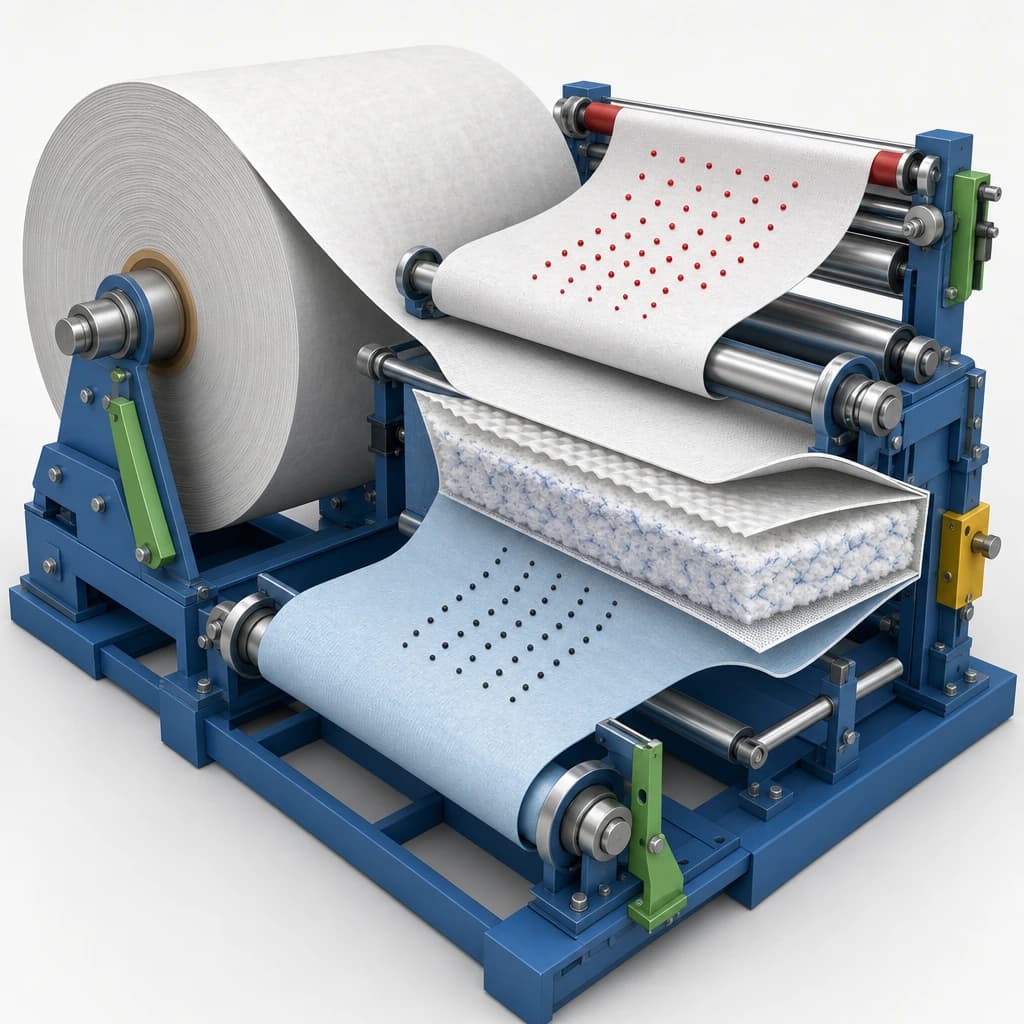
Raw-feed intake

01 · FD roll + wrap-sheet unwind

Multi-feed
Generated split/cutaway of a large raw-material unwind roll feeding dual wrap-sheet webs through guide rollers
GPT Image 2 cutaway: FD roll, wrap-sheet unwind, dual web feeds, and guide rollers.

The large roll/unwind area is the line's raw-material throat: fluff and wrap-sheet webs are presented, guided, and tensioned before joining the absorbent-core path.

Think of it as the supply rail: wide webs enter under control, then split into liner-side and poly-side sheet paths so later stations can build the pad around a stable carrier.

Inputs
Sam + Fluff · FD roll · Liner-side wrap sheet · Poly-side wrap sheet
Moves
Unwind → Guide → Align → Feed into pad stream
Output
Stabilized wrap-sheet streams feeding pad debulking and core assembly.
Visible source labels
  • FD
  • Sam + Fluff
  • Liner side Wrap sheet
  • Poly side Wrap sheet
  • G1
  • G2

Acquisition-layer feed

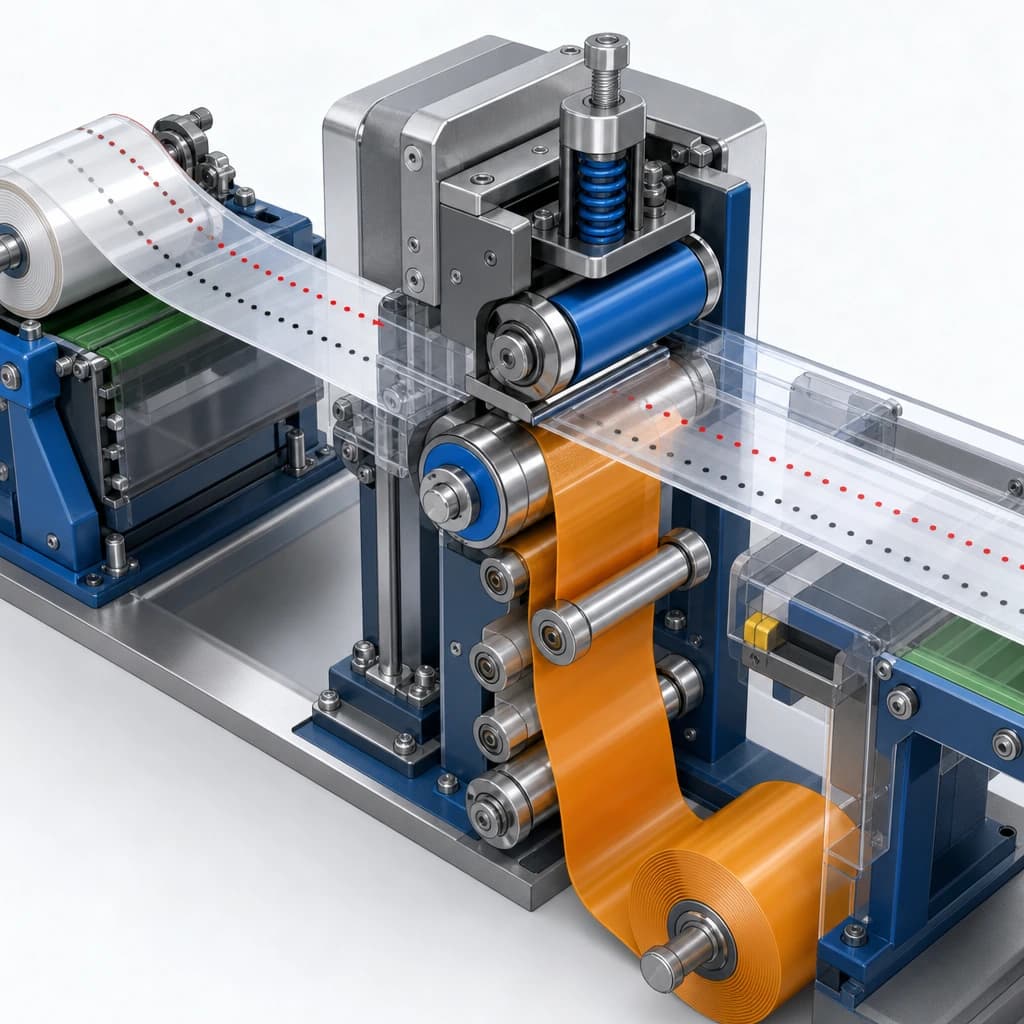
02 · Surge cutter + liner merge

Multi-feed
Generated split/cutaway of surge material and liner merging through cutter and guide rollers
GPT Image 2 cutaway: surge cutter, liner path, and web merge.

Surge material and liner are cut, guided, and married into a combined stream before the pad-forming stations take over.

This is where top-sheet handling becomes a laminate problem: the acquisition/surge layer has to land on the liner in the right position before the core stack gets thicker.

Inputs
Surge · Liner · Guide points G3/G4
Moves
Cut surge → Guide liner → Merge web paths → Hold registration
Output
Combined surge-and-liner path feeding the upper assembly.
Visible source labels
  • Surge Cutter
  • G3
  • G4
  • Surge
  • Liner
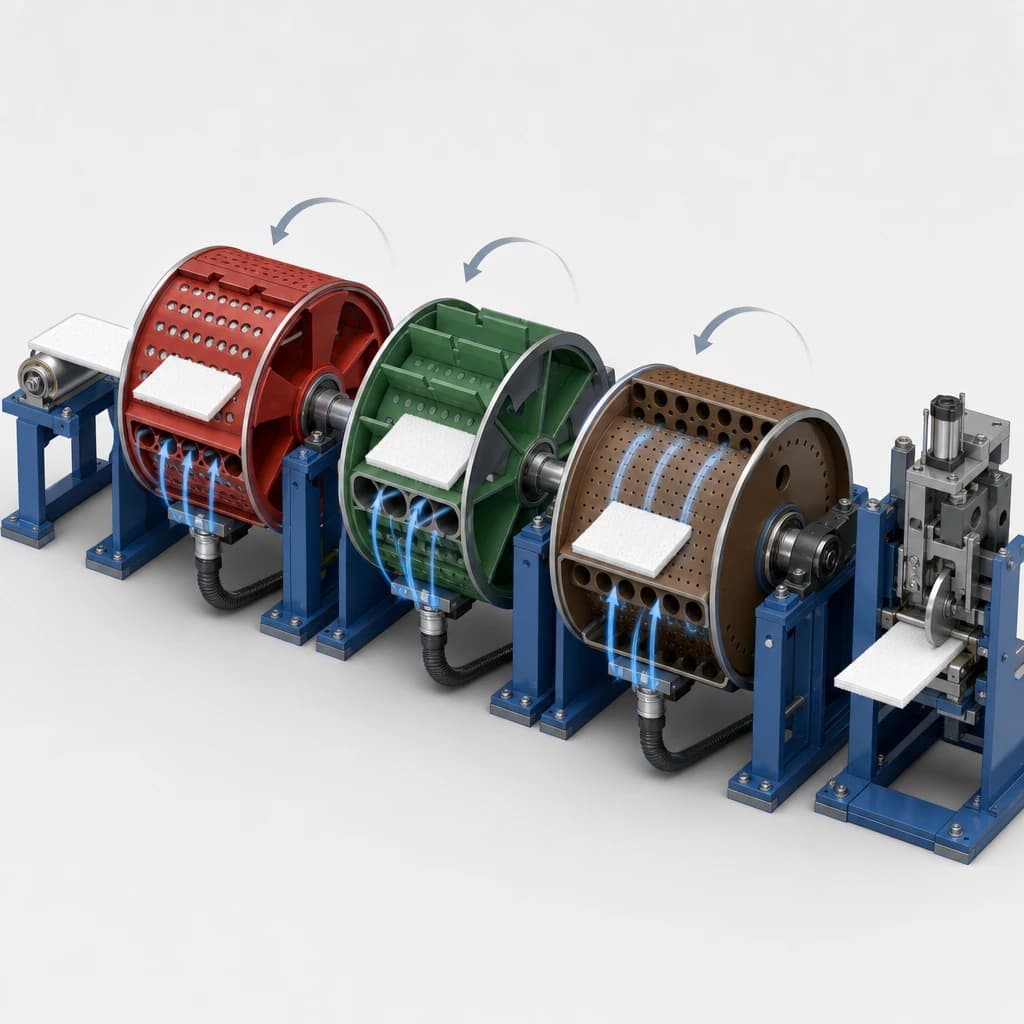
  • Surge & Liner

Core shaping

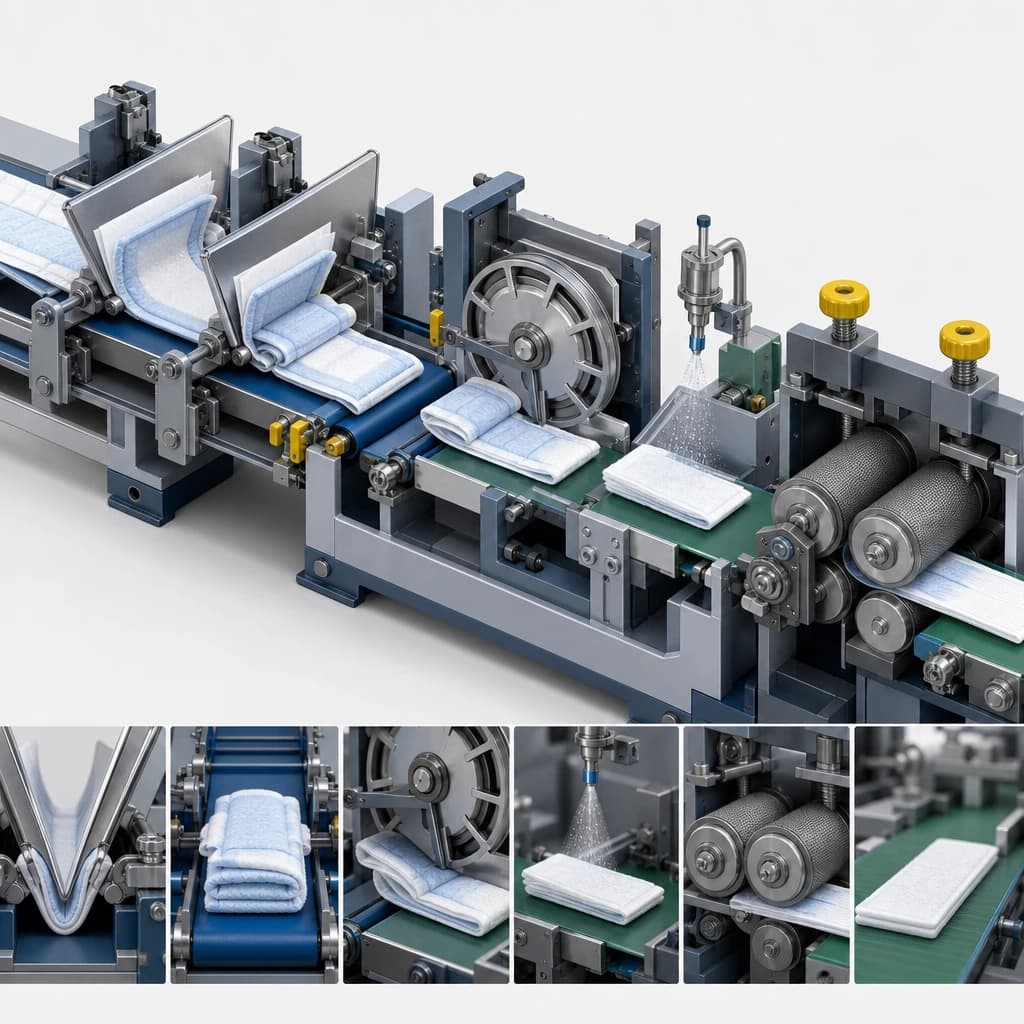
03 · Pad folding, spacing, cutting, debulking

Flow →
Generated split/cutaway of pad folding, spacing, cutting, perfume input, and debulking rollers
GPT Image 2 cutaway: pad fold, space, cut, perfume, and debulk train.

The pad train turns a thick absorbent stream into repeated, correctly spaced pad units with sealed ends, optional perfume input, and reduced bulk.

This is the density-and-repeatability section: it folds the pad into shape, spaces repeat lengths, cuts the pattern, and compresses bulk so downstream folding is predictable.

Inputs
Absorbent pad stream · Perfume input · Combined liner/surge feed
Moves
Fold → Space → Cut → Tack → Compress
Output
Repeated low-bulk pad assemblies ready for insert/body integration.
Visible source labels
  • End seal tacker
  • Pad Folding Unit
  • Pad Spacing Unit
  • Pad cutter
  • Perfume
  • Pad De-bulker

Stretch-system feed

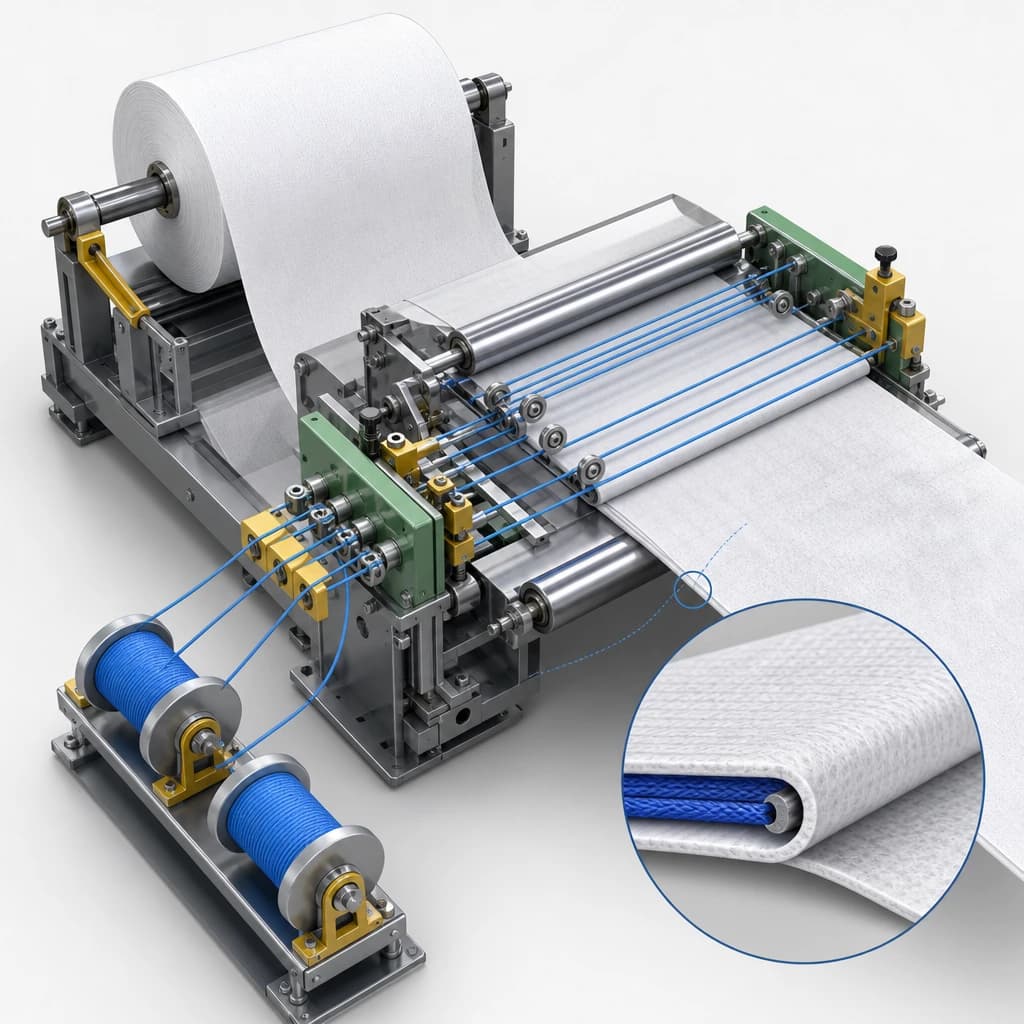
04 · Poly, OC flap, leg and flap elastic feeds

Flow →
Generated split/cutaway of poly roll, flap web, and elastic threads guided into a folded edge
GPT Image 2 cutaway: poly, OC flap, leg elastic, and flap elastic feed.

The lower Section 1 path feeds poly, flap material, and elastics so the pants product can gain stretch, fit, and leakage-control geometry.

This is the fit subsystem: thin elastic lanes and flap webs must arrive under stable tension, otherwise the final pant shape wrinkles, drifts, or loses containment performance.

Inputs
Poly roll · OC flap · Flap elastic · Leg elastic
Moves
Unwind → Tension → Guide → Place elastic into flap/body zones
Output
Prepared stretch and flap streams ready to join the body web.
Visible source labels
  • Poly
  • G17
  • OC flap
  • Flap elastic
  • Leg elastic
  • G5

Section 2

Insert handling, re-pitch, folding, bonding

The middle band uses cutoff, transfer drums, re-pitch, tucking, folding conveyors, and panel bonding to put insert geometry into the pants body.

The visible section arrow points right-to-left.

Insert timing and orientation

05 · Insert tacker, cutoff, transfer, rotor, re-pitch drums

← Flow
Generated split/cutaway of insert cutoff, transfer drum, rotor, re-pitch drum, and exit roller
GPT Image 2 cutaway: insert tacker, cutoff, transfer, rotor, and re-pitch drums.

The insert train cuts and transfers discrete inserts while drums rotate them, space them, and re-pitch them for the body-web cadence.

This is the clockwork heart of the line: a continuous web becomes discrete inserts, then drum surfaces change spacing and orientation without letting registration drift.

Inputs
Prepared insert web · Cutoff timing · Transfer drum vacuum surface
Moves
Tack → Cut off → Transfer → Rotate → Re-pitch
Output
Timed inserts aligned to the downstream folding and panel-bonding cadence.
Visible source labels
  • Insert tacker
  • Insert Cut off unit
  • Insert X’fer drum
  • Insert rotor
  • Insert Re-pitch drum
  • Roller after re-pitch

Body forming

06 · Panel addition, tucker, bi-fold, folding, panel bonder

← Flow
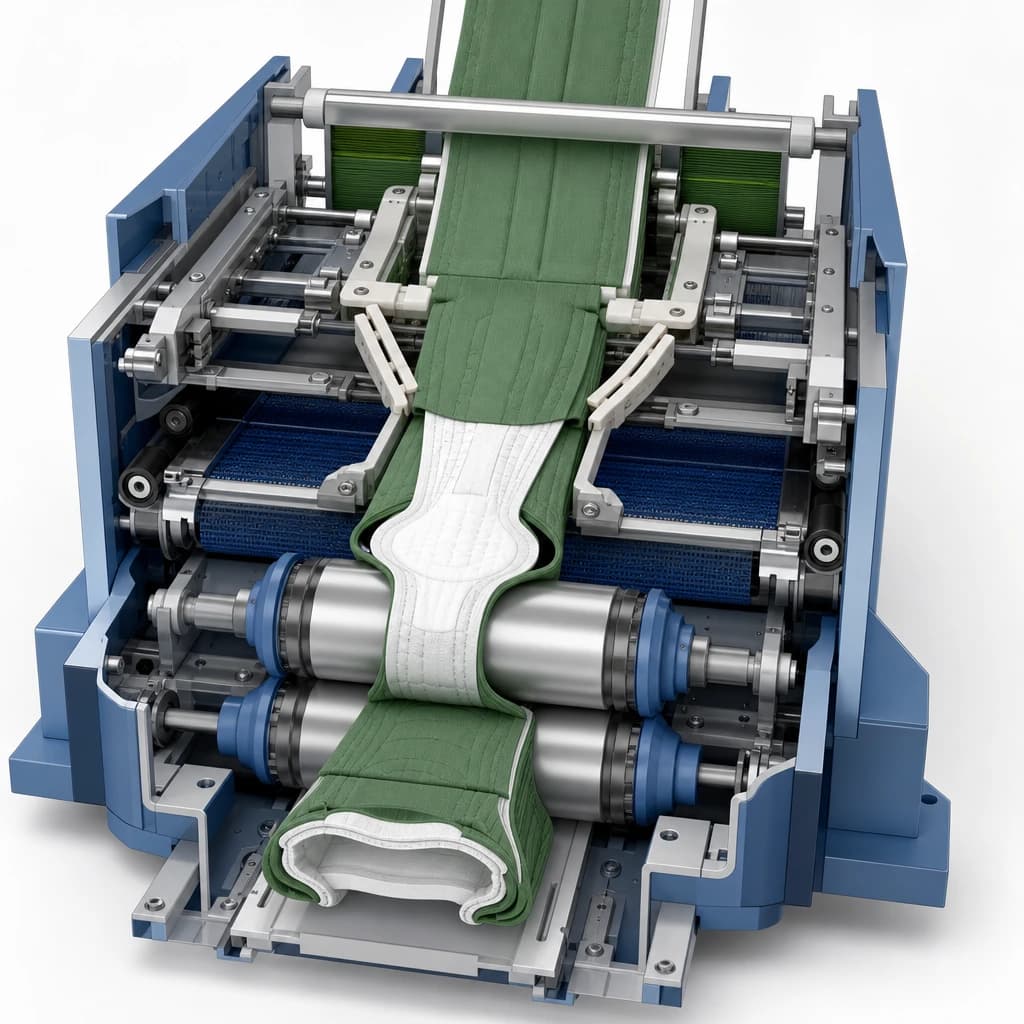
Generated split/cutaway of panel addition, tucker fingers, folding rails, twist belt, and bonding rollers
GPT Image 2 cutaway: panel addition, product tucker, folding, twist, and bonding.

Panels are added to the insert stream, tucked, folded, twisted into position, and bonded so the pant body can hold its final garment geometry.

This is where flat laminate starts behaving like a garment: panels join the insert, folding rails create symmetry, and the bonder locks the panel/body interfaces.

Inputs
Panel feed · Re-pitched insert stream · Fold conveyors
Moves
Add panel → Tuck → Bi-fold → Twist → Bond
Output
Folded and bonded pant-body assemblies moving toward final finishing.
Visible source labels
  • Panel addition to insert
  • Product tucker unit
  • Bi-Fold Conveyor
  • Product folding conveyor
  • Twist conveyor
  • Panel Bonder

Section 3

Final cut, rejection, pant output, stacker

The bottom band compresses, cuts, rotates, rejects bad products, sends good pants to bulk pack, and stacks them for downstream handling.

The visible section arrow points right-to-left into stacking.

Final separation and quality routing

07 · Press belt, final cutoff, product rotor, reject gates

← Flow
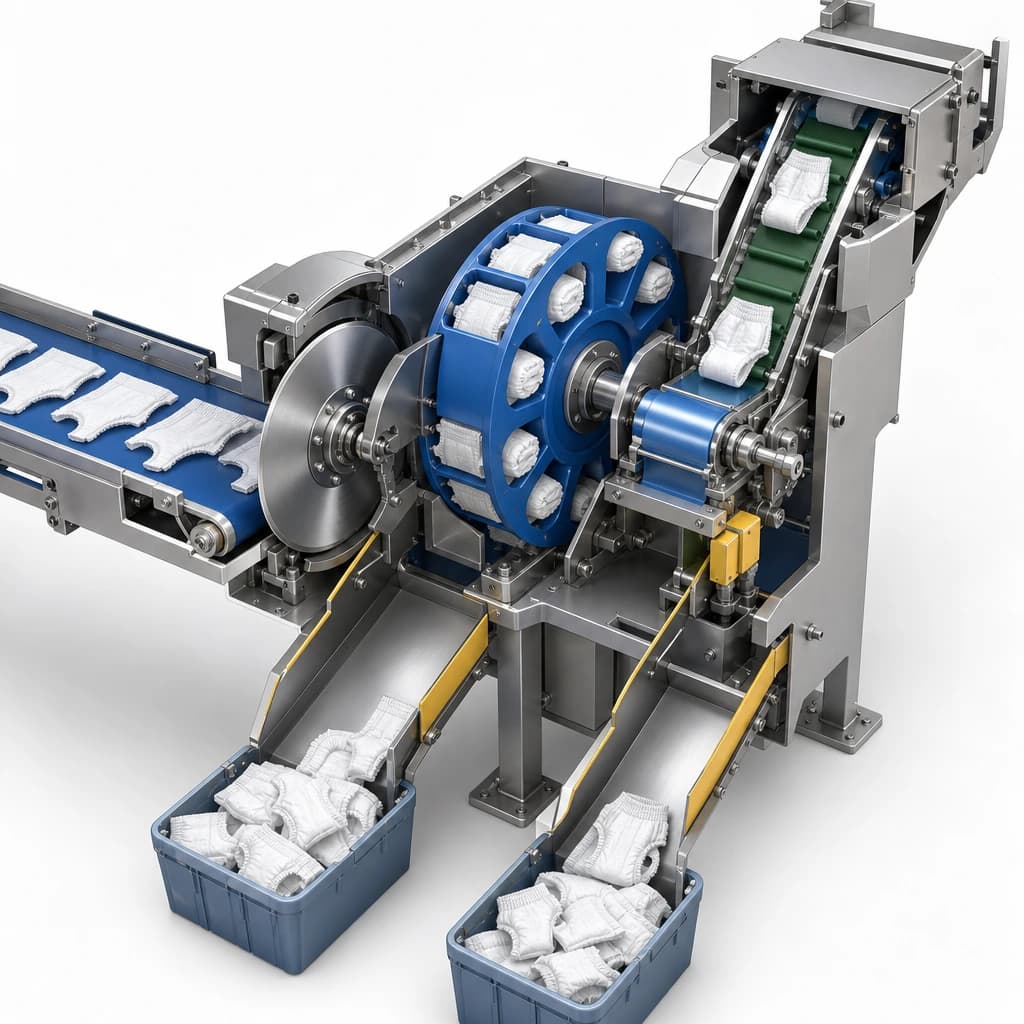
Generated split/cutaway of press belt, final cutoff, product rotor, aperture module, and reject chutes
GPT Image 2 cutaway: final cut, product rotor, aperture module, and reject gates.

The finishing path presses the web, cuts final products, transfers them through the product rotor, and drops rejected units before good products continue.

This section turns continuous assembly into individual products and protects the output stream: reject gates remove bad units before packing sees them.

Inputs
Folded body web · Aperture-module feed · Rotor/transfer drum timing
Moves
Press → Final cut → Rotate → Transfer → Reject bad units
Output
Accepted pant products continue left; rejected units drop out at Reject 2 or Reject 3.
Visible source labels
  • Press belt Before final cut off
  • final cut off
  • Product Rotor
  • X’fer drum after product rotor
  • (C 23)
  • Reject 2
  • Aperture module
  • (C 26)
  • Reject 3

Packing handoff

08 · Pant output, bulk pack, stacker

← Flow
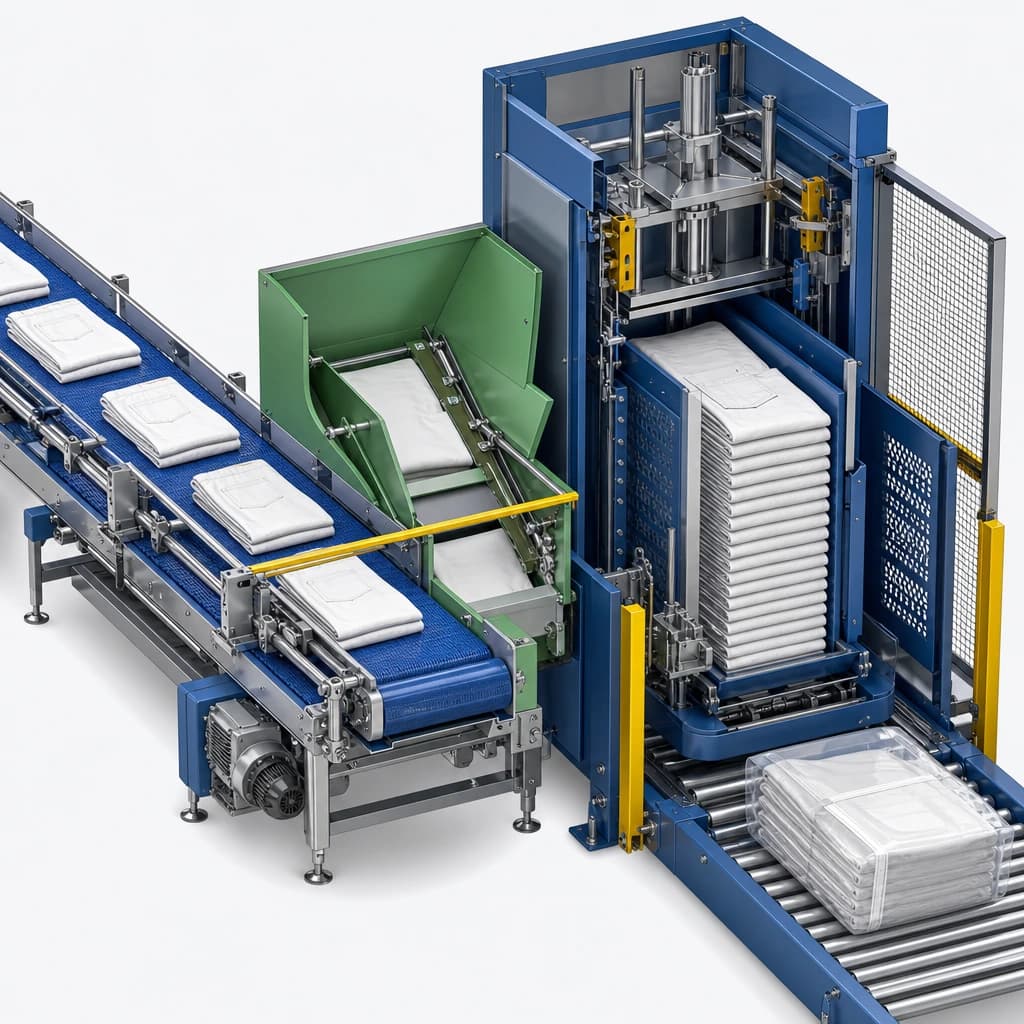
Generated split/cutaway of finished pant products traveling through bulk pack conveyor into a stacker cassette
GPT Image 2 cutaway: pant output, bulk pack lane, and stacker.

Finished pants move into the pack lane and stacker, where individual products become a controlled pile for downstream packaging.

This is the line's exit discipline: speed is converted into countable stacks so packaging can take over without losing orientation or count accuracy.

Inputs
Accepted pant products · Bulk pack conveyor · Stacker infeed
Moves
Convey → Orient → Count → Stack
Output
Stacked pant products ready for final package handling.
Visible source labels
  • Pant
  • Bulk pack
  • Stacker