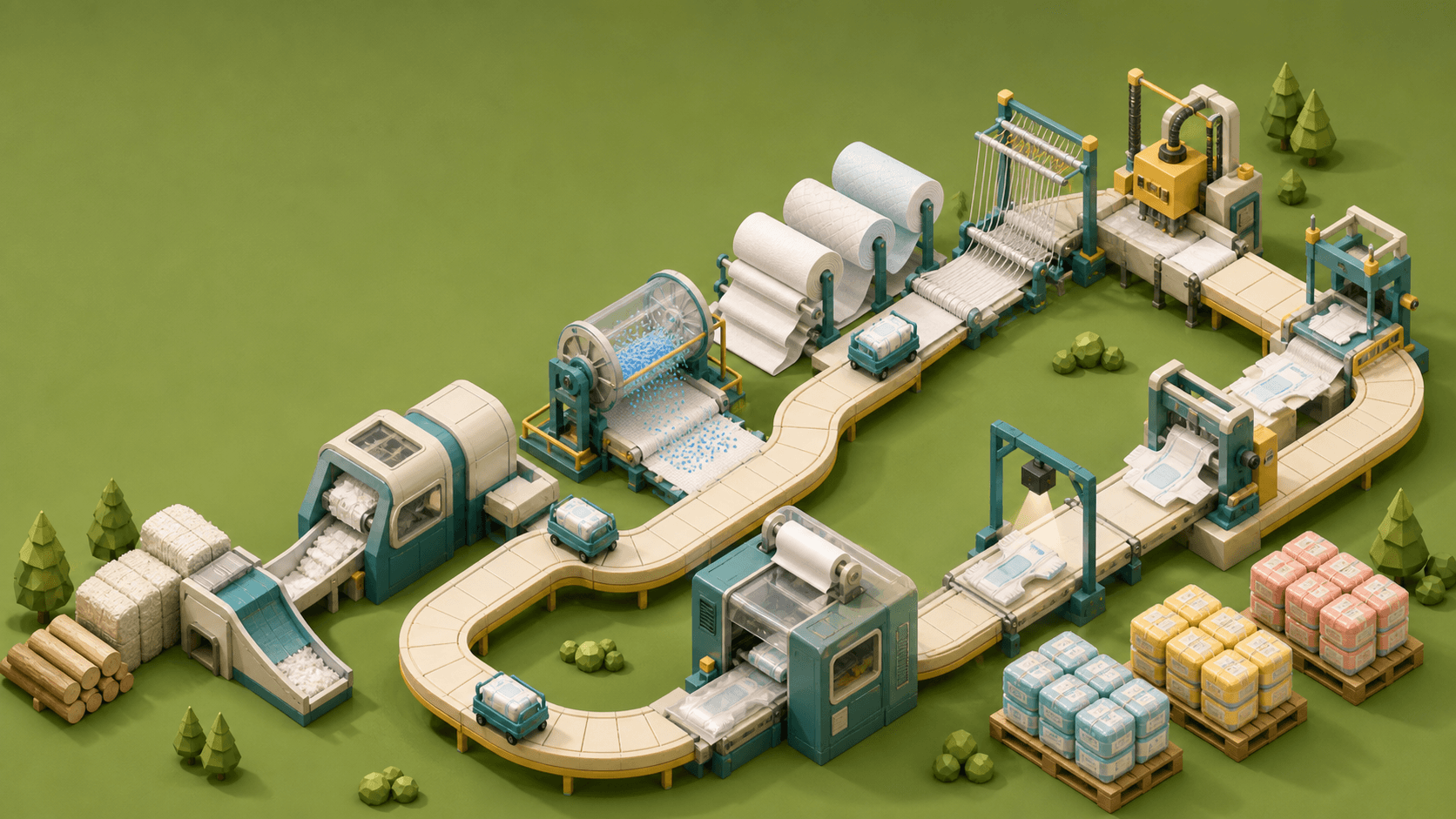
A small factory for a large daily object
DiaperWorks
Ride one carrier through the line that turns wood pulp, absorbent polymer, nonwovens, film, elastic, and glue into a packed disposable diaper.
Guided factory tour
Act 1 · absorbent core
Station 1 of 11
Space play/pause · S next · R restart
What this teaches
A diaper is a routing system wearing a garment shape.
The topsheet admits liquid, the core distributes and retains it, the backsheet stops leakage, and elastics hold that architecture against the body. The converting line has to maintain that logic at every repeat length.
Accuracy boundary
This is a learning model of common disposable-diaper components and conversion steps, not a supplier-specific line layout. Exact machinery, line speed, core recipes, and inspection criteria vary by product, region, and manufacturer.
Further reading
The core material model follows common absorbent-hygiene construction: fluff pulp and superabsorbent polymer in the absorbent mass, a permeable topsheet, a leakage-resistant backsheet, and fastening or elastic systems. The guided-factory interaction is inspired by the isometric learning simulations collected by Laurentiu Raducu.